Why Storyblok is Ideal for Localization Marketing

Storyblok is the first headless CMS that works for developers & marketers alike.
Quick overview
- Localization marketing adapts language, currency, imagery, and buying context to a market. It's broader than translation, which converts words only.
- 75% of international shoppers want to buy products online in their native language, and 59% of non-English-speaking consumers rarely or never make purchases from English-only websites, findings from Capital One Shopping's February 2026 cross-border e-commerce research (opens in a new window).
- 27% of tech CEOs say they lack a dedicated resource for building regional campaigns, according to Gartner's Digital Markets research (opens in a new window).
- Storyblok supports three internationalization models, AI-assisted translation, and integrations with five major translation management platforms. Find out more in Storyblok's internationalization documentation (opens in a new window).
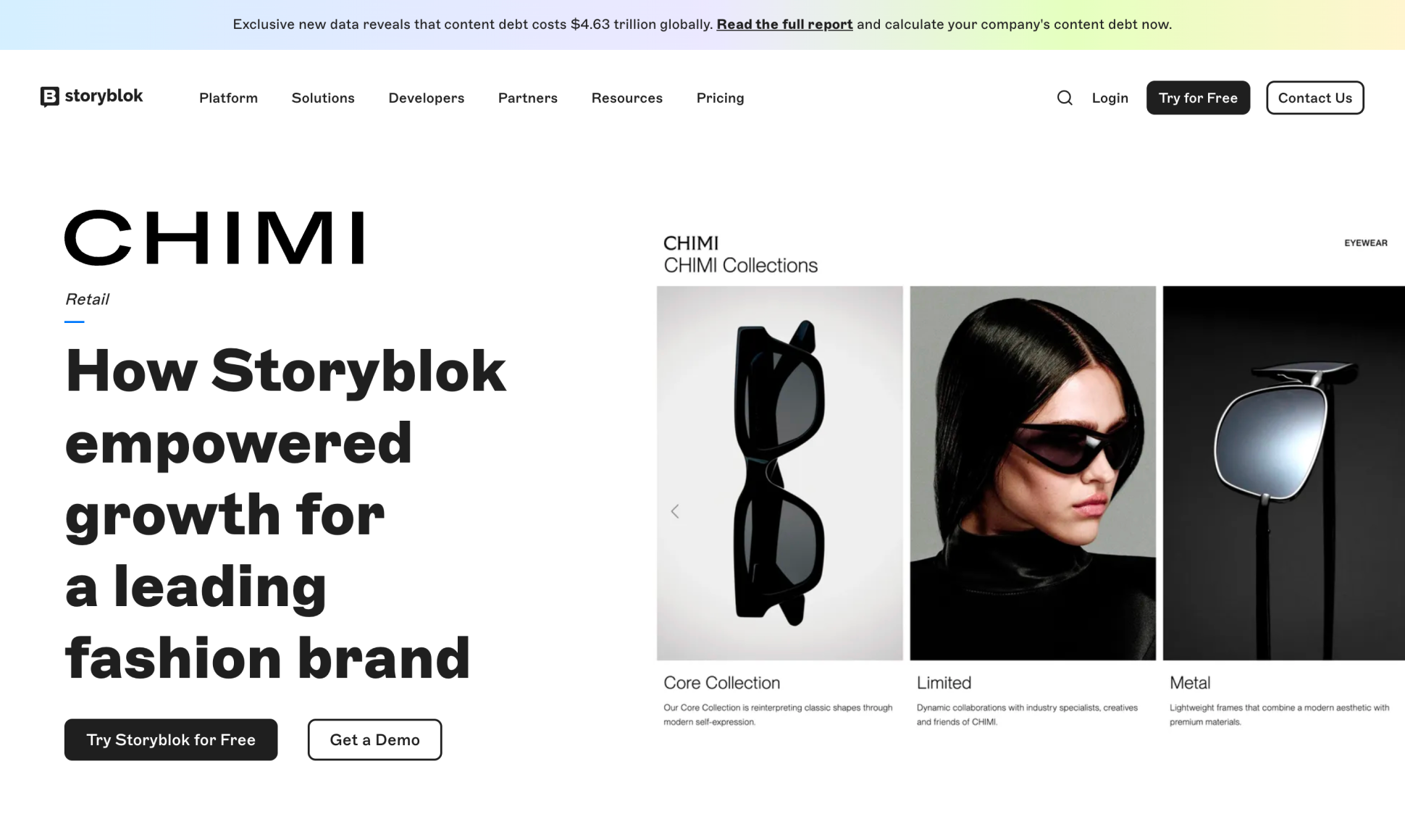
- Eyewear brand CHIMI cut content work by roughly 50% and now opens a new market in an existing language in hours rather than weeks after moving to Storyblok. See the full case study.
What is localization marketing?
Localization marketing adapts campaigns and content to resonate with a specific region or market. It starts with translation but goes further, covering:
- Currency conversion and locally preferred payment methods
- Visuals and colors adjusted for cultural context
- Dates, phone numbers, and addresses formatted per local convention
- Messaging that reflects local buying habits and humor
- Compliance with regional advertising regulations, which vary by country
Localization marketing vs. translation vs. internationalization: translation converts words. Localization marketing converts context: the offer, the imagery, the call to action. Internationalization is the technical groundwork, building your content model and code so localization is possible without a rebuild each time you enter a new market.
Coca-Cola's "Share a Coke" campaign (opens in a new window) is a well-documented example of this model: a single global concept, personalizing bottles with consumer names, adapted locally to match naming conventions and cultural context in each market it launched in.
Why content localization is important
Content localization matters because digital distribution has removed geography as a barrier, but cultural distance remains, and the revenue impact is measurable.
- Reach without relevance doesn't convert: Capital One Shopping's 2026 research (opens in a new window) found that 75% of international shoppers want to buy products online in their native language, and 59% of non-English-speaking consumers rarely or never buy from English-only websites. The same research found 92% of global consumers prefer buying from sites that show prices in their local currency, and a third say they'd abandon a purchase if pricing only appeared in US dollars. Together, these figures point to a hard ceiling on addressable market size, not just a dip in conversion rate.
- Literal translation carries real risk: Words and images can carry different meanings across dialects. A campaign that lands in Mexico can misfire in Spain despite sharing a language, and getting this wrong costs more than a poor conversion rate: it can mean pulled ads or reputational damage.
- Regional regulation limits what you can say: Advertising standards around health, finance, and consumer claims differ by country. Non-compliant campaigns get pulled or fined regardless of intent.
Gartner's Digital Markets research (opens in a new window) found that 27% of tech CEOs say they lack a dedicated resource for developing regionalized marketing campaigns. That gap shows up operationally as marketing teams manually re-briefing translators per campaign, developers rebuilding page templates per region, and no single source of truth for what's been localized where.
What marketers need to localize content effectively
Three CMS-level requirements, and the team roles they typically map to, determine whether localization scales:
Remote access and permissions
Central marketing teams need to collaborate with regional editors and external translators without losing control. Team roles typically include a content owner who sets the source copy, a regional editor who adapts it for their market, and a translator or reviewer who signs off before publishing. Role-based permissions in the CMS enforce that a regional editor can touch their market's content, not the global brand assets or other regions' campaigns.
Streamlined content workflows
Once you're running campaigns across markets, asset volume multiplies fast: copy, images, video, and metadata, each needing review and approval per locale. Without a structured workflow with defined stages, this either slows to a crawl or ships with errors. Unmanaged localization work also builds into content debt over time: outdated translations, inconsistent regional messaging, and no clear owner for cleanup.
Analytics and translation platform integration
Marketers need to see which localized campaigns perform, and where. That requires analytics integration plus a direct connection to a translation management system, so translated content doesn't get manually copy-pasted between platforms, which is where translation errors and version mismatches usually originate.
How Storyblok supports localization marketing
Omnichannel content delivery
As a headless, API-first CMS, content is managed separately from the site or app that displays it and delivered via an API. Storyblok lets developers build the frontend independently of how marketers manage content.
Component-based content structure
Storyblok organizes content into reusable, nestable blocks. Teams build a template once and reuse it across markets, changing only what needs to change per locale instead of duplicating entire page builds.
This structure is also what makes translation manageable at scale. When content is broken into specific fields, such as a title, a CTA, or a product spec, rather than one undifferentiated block of text, localization can happen at the component level. A market that needs a different call to action or a region-specific disclaimer gets that one component swapped, not the whole page rebuilt.
See how structuring content into reusable fields makes translation faster and more consistent in Crowdin's guide to content modeling for CMS localization.
Three internationalization strategies
Storyblok supports three internationalization models, documented in full in Storyblok's internationalization guide (opens in a new window). Picking the right one matters, since switching later means restructuring content.
| Strategy | Best for | How it works |
|---|---|---|
| Field-level translation | Markets where content structure stays the same, only the language changes | One story, multiple language versions per field, toggled per locale |
| Folder-level translation | Markets needing different content structure, not just different languages | Dedicated folders per language or region, linked via the Dimensions app |
| Space-level translation | Large, multi-team organizations serving distinct regions, channels, or brands | Separate spaces synced via CLI and Management API |
Content workflows and version history
Storyblok supports custom, staged publishing workflows, scheduled release groups, and full change history showing who last edited a given campaign.
Translation platform integrations
Beyond Lokalise (opens in a new window), Storyblok integrates with Smartling (opens in a new window), Localazy (opens in a new window), LingoHub (opens in a new window), and Crowdin (opens in a new window), plus dedicated apps for translatable slugs and import/export of translatable fields in XML and JSON. Teams already standardized on one of these platforms don't need to rebuild their translation pipeline to adopt Storyblok.
How to get started
Setting this up takes three steps: configure your locales in Internationalization settings, decide field-level versus folder-level per content type based on the table above, then connect a translation platform integration so translators work in their existing tool rather than inside the CMS directly.
Inside field-level translation, editors get an AI-assisted translation option directly in the toggle menu, alongside opening Google Translate or entering a manual translation. This shortens the loop between content approved in the source language and content live in the target locale.
Real-world results: how CHIMI scaled localization with Storyblok
Swedish eyewear brand CHIMI ran into a familiar wall: their WordPress and WooCommerce stack couldn't keep pace with localizing content and payment options across markets as they expanded internationally. After moving to Storyblok, working with agency ROIROI, CHIMI's team cut content-related work by roughly half, improved product page load time twofold, and reached a 92 Lighthouse SEO score.
CHIMI's CTO partner at ROIROI noted that localization involves far more than adding languages, and that Storyblok gave the team real control over market-specific payment options. Opening a new market in a language CHIMI already supports now takes a few hours instead of a lengthy rebuild.
Read the full breakdown of how CHIMI cut content work in half and now launches new markets in hours, in the CHIMI case study.
| Traditional CMS | Headless CMS (Storyblok) | |
|---|---|---|
| Content structure | Tied to one template per page | Reusable blocks, shared across locales |
| New regional website | Often built around a single frontend, so new markets can mean template rework | Delivered via API to any frontend |
| Non-technical editing | Varies by platform; often limited outside the template | Visual editor, no code required |
| Scaling to new markets | Usually manual duplication per market unless multi-site tooling is added | Field, folder, or space-level translation |
Storyblok's architecture also aligns with MACH principles (Microservices, API-first, Cloud-native, Headless), an independent industry standard for composable technology that several enterprise buyers now use as a procurement criterion.
Don't skip multilingual SEO
At minimum:
- Set hreflang tags correctly so search engines serve the right locale to the right audience, per Google's official localized-versions documentation (opens in a new window)
- Localize metadata rather than machine-translating verbatim
- Research region-specific keywords, since search behavior varies even between markets sharing a language
- Build region-relevant backlinks rather than relying solely on your primary market's link profile
Storyblok's translatable slugs and per-locale metadata fields support this, and locale codes should follow the IANA language subtag registry (opens in a new window) to keep hreflang implementations valid across markets.
Learn why well-structured content ranks better in AI-driven search results in Is a Headless CMS Better for LLM SEO?
The takeaway for global marketing teams
Localization marketing isn't a translation task bolted onto a finished campaign. It's a structural decision that shapes how much of the market a brand can actually reach, and it depends on having content built to support it from the start: reusable components, a defined internationalization model, and a workflow that doesn't stall on developer time.
Storyblok's field, folder, and space-level translation options, paired with AI-assisted translation and integrations across the major translation platforms, give marketing and development teams that foundation without forcing a tradeoff between speed and control. CHIMI's results show what that looks like in practice: less manual work, faster market entry, and a stronger technical foundation for search visibility in the process.
Frequently asked questions (FAQs) on localization
Is localization marketing the same as translation?
No. Translation converts language. Localization marketing adapts language, imagery, currency, tone, and compliance to fit a market.
Does localization actually affect revenue, or is it just a nice-to-have?
It's measurable. Capital One Shopping's 2026 cross-border research found 75% of international shoppers want to buy in their native language, and 59% of non-English speakers rarely or never buy from English-only sites.
What CMS features matter most for localization marketing?
Reusable content blocks, a translation workflow that doesn't require developer involvement for every change, and integrations with translation management platforms.
Does Storyblok use AI for translation?
Yes. Field-level translation includes an AI-assisted translate option inside the editor, alongside manual entry and Google Translate.
Which translation platforms integrate with Storyblok?
Lokalise, Smartling, Localazy, LingoHub, and Crowdin.
What's the difference between field-level, folder-level, and space-level translation?
Field-level keeps one content structure with translated fields. Folder-level allows different structure per locale via the Dimensions app. Space-level separates entire spaces for large, multi-team organizations.