What Is MACH Architecture? A Complete Guide to MACH CMS

Storyblok is the first headless CMS that works for developers & marketers alike.
MACH has become an established approach to building flexible enterprise technology. Instead of relying on a single suite to handle every capacity, MACH architecture breaks the technology stack into dependent components that can be connected, replaced, and evolved as business needs change.
That flexibility has taken on new importance as organizations move AI from isolated experiments into production. MACH Alliance research among 600 enterprise technology decision-makers across seven markets found a significant gap between organizations with mature composable technology and those still at the beginning of their journey: 78% of organizations with fully implemented, scaled MACH technology report clear ROI from AI investments, compared with 13% of organizations in early planning stages.
But what exactly makes an architecture MACH? And what does it mean when choosing a CMS? Let's find out.
What is MACH architecture?
MACH stands for Microservices-based, API-first, Cloud-native SaaS, and Headless. Together, these architectural characteristics enable organizations to build composable technology ecosystems rather than relying on tightly coupled, monolithic platforms.
- Microservices-based: Business capabilities are divided into independent services that can be developed, deployed, and managed separately. This makes it possible to evolve individual parts of the stack without rebuilding the entire system.
- API-first: Functionality is designed to be exposed through APIs from the outset. APIs provide the connections between components and allow different systems to exchange data and functionality.
- Cloud-native SaaS: Software is delivered as SaaS and designed to take advantage of cloud capabilities such as elastic scaling, high availability, and automated updates.
- Headless: The backend (where content lives) is decoupled from the frontend (the "head," or however that content gets presented). One centralized backend can push content to as many frontends as needed, rather than being tied to one default presentation layer.
These characteristics remain fundamental to MACH architecture and MACH certification. In 2026, the MACH Alliance has also broadened the way it describes the architecture organizations need for the next generation of enterprise technology around three principles: Open, Composable, and Connected.
Open emphasizes portability, transparency, and freedom from unnecessary vendor lock-in. Composable means capabilities can be assembled, replaced, and evolved independently. Connected means systems are designed to interoperate across an ecosystem through APIs, real-time data, events, and increasingly agent-to-agent connections.
Together, these ideas extend the original MACH foundation for a technology environment increasingly shaped by AI and automation.
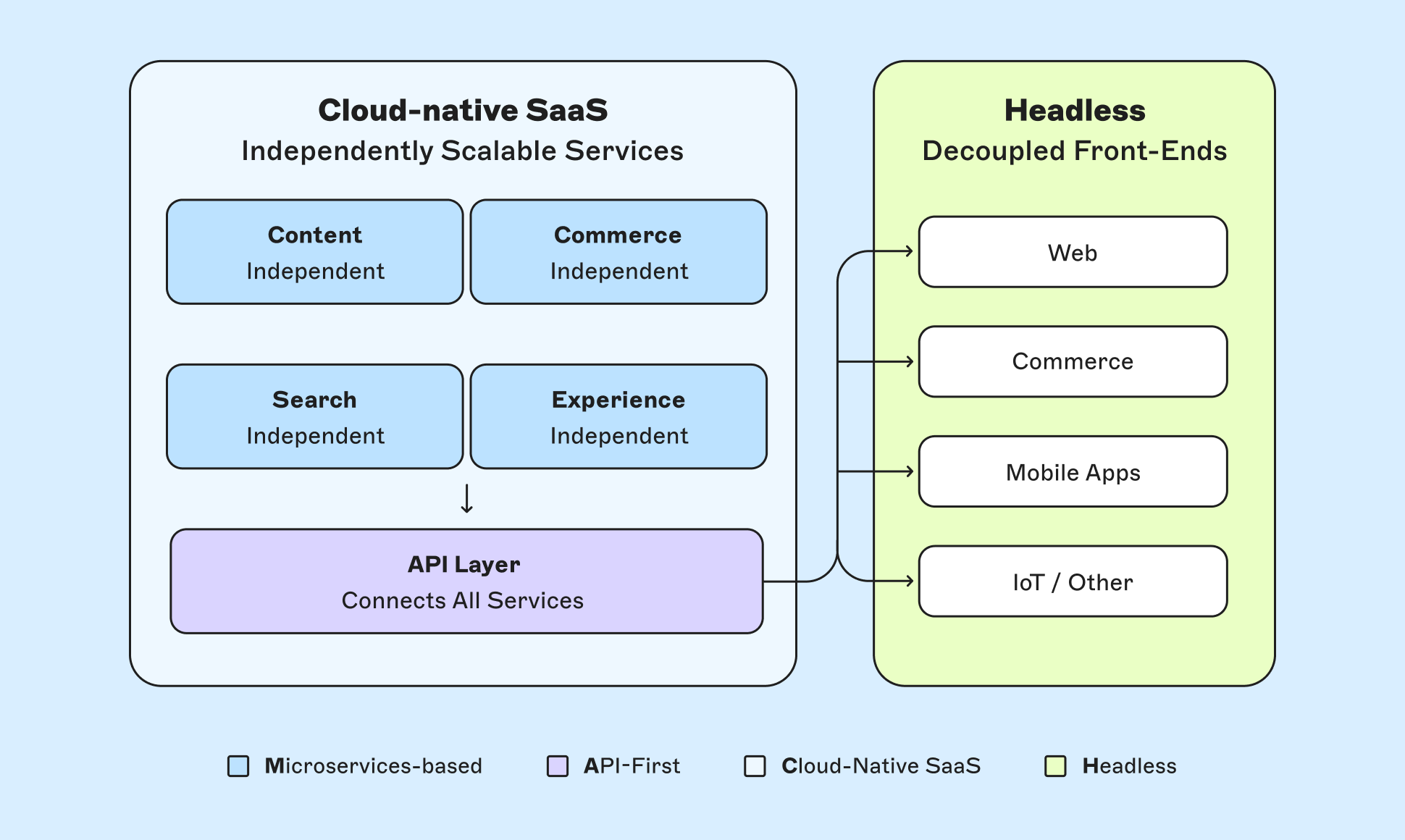
An API-first architecture allows independently selected capabilities to communicate while keeping presentation channels decoupled from the systems behind them.
Why MACH matters for modern enterprise technology
The original appeal of MACH was flexibility: organizations could move away from tightly coupled suites and build technology stacks from independently evolving capabilities.
That advantage remains, but the context has changed. Enterprise technology now also needs to support AI systems that can access information, interact with business capabilities, and coordinate actions across multiple systems.
The MACH Alliance's 2026 Enterprise Technology Report found that organizations with mature composable architectures are:
- 6x more likely to report clear AI ROI, with 78% reporting clear returns compared with 13% of organizations in early MACH planning stages.
- More prepared to support AI at scale, with 98% of composable-mature organizations reporting that capability.
- Able to deploy AI faster, with 94% reporting that composable architecture increases the speed of AI deployment.
The architecture helps explain the relationship. AI applications and agents need structured ways to access data and interact with business systems. API-first architecture exposes capabilities through defined interfaces, while modular services reduce the need to connect AI to one tightly coupled application.
That doesn't mean adopting MACH automatically produces AI ROI. Organizational readiness, data quality, governance, integration design, and operating models still matter. But an open, composable, and connected architecture can provide a stronger foundation for moving AI beyond isolated pilots and into workflows that span the business.
Reasons to choose a MACH CMS
1. Build a technology stack around your needs
Every organization has different requirements, and those requirements change over time. A monolithic platform can bundle content management, commerce, search, personalization, and other functionality into one system, whether every capability is needed or not.
MACH architecture takes a modular approach. Organizations can select the capabilities that fit their requirements and connect them through APIs rather than committing the entire technology stack to one platform.
The trade-off is that greater choice can also introduce greater architectural and operational complexity. Integrations need to be designed and maintained, responsibilities need to be clear, and teams need the skills and processes to manage a composable environment effectively.
For organizations with complex digital ecosystems, however, that additional flexibility can make it easier to evolve the stack as requirements change rather than repeatedly replacing an entire platform.
2. Scale more flexibly
Cloud-native architecture allows services to scale according to their individual needs rather than forcing the entire platform to scale as one unit.
A headless CMS also separates content management from the presentation layer. The same centralized content can support websites, apps, kiosks, AI assistants, and other digital experiences without requiring a separate CMS infrastructure for every frontend.
This doesn't remove every scaling constraint, but it gives teams more flexibility to scale and optimize individual parts of the architecture independently.
3. Reduce the burden of platform maintenance
Cloud-native SaaS shifts much of the underlying platform maintenance to the vendor. Automatic updates can keep SaaS components current without customers managing traditional platform upgrades themselves.
Because MACH components communicate through APIs and the frontend is decoupled from backend functionality, development teams can also make changes to individual parts of the experience without necessarily changing the entire stack.
For content teams, headless architecture makes it possible to manage content centrally and distribute it to multiple channels. For developers, it provides greater freedom to choose frontend technologies suited to each experience.
4. Adapt the stack as requirements change
One of the main advantages of MACH is the ability to evolve individual capabilities rather than treating the technology stack as a single inseparable platform.
Microservices-based architecture separates business capabilities. API-first design provides standardized ways for components to communicate. could-native SaaS supports independently managed and scalable services. Headless architecture avoids tying backend functionality to one presentation layer.
Together, these characteristics can make it easier to introduce new capabilities, replace components, support new channels, or integrate emerging technologies without rebuilding the entire digital ecosystem.
What actually determines success with MACH
Choosing MACH-aligned technology is only part of the transition. The benefits of composability depend heavily on how the architecture is implemented and operated. A few factors matter in particular:
- Operating model, not just tooling. Independent services still need clear ownership, coordinated releases, governance, and processes that prevent a composable stack from becoming organizationally fragmented.
- Integration architecture over tool selection. Choosing best-of-breed tools is the easy part; the harder, more valuable work is in how cleanly those services actually connect and share data.
- Clear ownership across experiences. When multiple teams and systems contribute to one customer experience, responsibilities need to be explicit. Otherwise, flexibility at the technology layer can create complexity at the organizational layer.
- Governance and standards. Open architecture does not mean uncontrolled architecture. Security, data governance, API standards, observability, and AI governance become increasingly important as more services, and potentially more AI agents, interact across the ecosystem.
Storyblok and the MACH Alliance
Knowing which vendors genuinely embody MACH principles is where the MACH Alliance comes in. It's a vendor-agnostic, not-for-profit organization with a global community of 100+ member companies, championing open, composable, and connected architecture as the standard for modern, AI-ready technology. Certification requires demonstrating real adherence to MACH principles, backed by production deployments and reference customers. Not just a marketing claim.
Storyblok is a certified member of the MACH Alliance, and builds toward these same principles directly: a genuinely headless, API-first architecture designed to scale, connect cleanly to the rest of a composable stack, and expose content in a structured way that both marketers and AI agents can use.
Key takeaways
MACH architecture is the practical standard most enterprises build toward today, and composable, connected infrastructure is a deciding factor in whether AI investments produce results at scale or stay stuck as disconnected pilots. Getting real value from MACH depends less on whether an organization has adopted composable tools, and more on whether its integration architecture, team structure, and content model are actually built to make use of them, including by the AI agents that are a core consumer of enterprise content today.