Jamstack for Marketers: What Is a Jamstack CMS?

Storyblok is the first headless CMS that works for developers & marketers alike.
If you've heard the term "Jamstack" and are trying to figure out what it means for your website, here's the short version: it's a web architecture that made sites faster and more secure by separating the frontend from the backend, and while the term itself has faded from everyday use, the architecture it described won so thoroughly that it's now just how modern websites get built by default.
What is Jamstack?
Jamstack is a term coined by Netlify co-founders Mathias Biilmann and Chris Bach and popularized by Biilmann's 2016 SmashingConf talk. The original concept centered on three components—the "Jam" in Jamstack:
- JavaScript handles dynamic functionality in the browser, without dictating which framework or library you use.
- APIs turn server-side functions and third-party services into reusable calls accessed over HTTPS.
- Markup is pre-rendered as static files at build time, rather than assembled on a server for every request.
A Jamstack CMS is simply a headless or decoupled content management system compatible with that approach where content lives independently of the frontend and gets pulled in via API.
What happened to the term
Here's the part most explanations of Jamstack now leave out: Netlify itself moved away from the Jamstack label in 2023, repositioning around composable web architecture. The community-run "State of Jamstack" survey, which had tracked adoption since 2020, ended in 2024 because, in the words of the developer who ran it, the community had moved on. The annual language shifted to headless commerce, composable architecture, and edge-first frameworks.
The ideas themselves didn't fail, quite the opposite. Pre-rendered content, API-driven backends, and CDN/edge delivery are now baseline assumptions in modern web development, built into frameworks like Next.js and Astro and platforms like Vercel, Netlify, and Cloudflare, whether or not anyone calls the result "Jamstack." If you're briefing an agency or a dev team today, "composable architecture" or "headless CMS" will get you a more accurate conversation than "Jamstack" will, but understanding the original concept still explains why the modern stack looks the way it does.
Traditional websites vs. composable (Jamstack-style) websites
Traditional websites run continuously on a web server: a CMS or database sends data to an application, which is sent to a web server, which delivers the site to the end user on request every time, for every visitor.
The Jamstack approach, now more commonly built through composable, headless architecture, decouples the frontend layer from the backend. The frontend is deployed directly to a content delivery network (CDN), pre-built ahead of time, while APIs connect it to whatever backend services or microservices it needs.
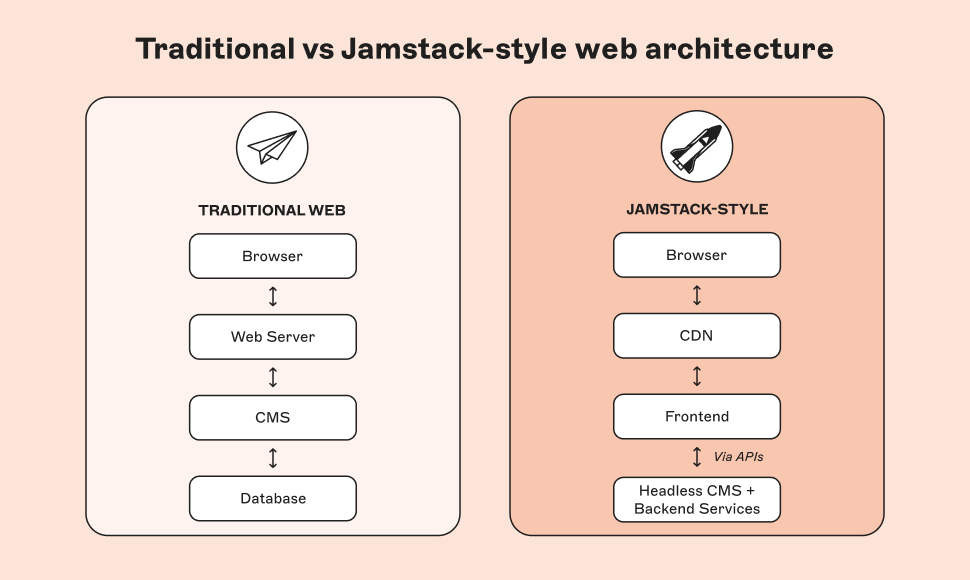
Traditional vs Jamstack-style web architecture
The result: a decoupled frontend served from a CDN, connecting to backend services and microservices via API only when needed, rather than a database and application server sitting in the request path for every visit.
At its simplest, the original Jamstack model differed from traditional dynamic websites in a few key ways:
| Static / pre-rendered | Traditional dynamic | |
|---|---|---|
| Rendering | Built ahead of time, served from CDN | Assembled on a server per request |
| Content | Can still be personalized via APIs and edge functions | Personalized directly on the server |
| Performance | Fast and secure by default | More dependent on server-side performance |
| Security | Smaller attack surface—no exposed server/database in the request path | More exposed to server- and plugin-level vulnerabilities |
One nuance worth mentioning is that the original all-static Jamstack model has itself evolved. Modern frameworks have moved beyond pure build-time generation, combining static generation with techniques such as incremental regeneration, server-side rendering, serverless functions, and edge rendering. That shift is what let this architecture support real-time personalization, live inventory, and user accounts (the things pure static sites originally struggled with) without giving up the speed and security benefits that made the approach popular in the first place.
Traditional CMS implementations can introduce additional performance and security considerations, particularly when they rely on third-party plugins, modules, or custom code that require ongoing maintenance.
Benefits of this architecture for developers
1. Faster performance
Serving pre-built markup and assets over a CDN, rather than assembling pages from an application server on every request, means faster load times and a better user experience by default.
2. Improved developer experience
Decoupling frontend from backend frees developers to focus on the experience layer, rather than splitting attention with backend infrastructure maintenance.
3. Increased security
A decoupled frontend has a smaller attack surface than a monolithic setup where the server and database sit directly in the request path.
4. Greater scalability
CDN delivery removes the need to manage server load directly, and edge functions handle dynamic behavior without reintroducing the scaling bottlenecks of a traditional server.
Benefits for marketers
1. Potentially lower infrastructure costs
Hosting pre-built static assets is typically far cheaper than running a dedicated application server continuously.
2. Better support for SEO and GEO
Fast load times and strong security were always SEO factors, and Jamstack-style sites tend to score well on both. Pre-rendered content can also make page content more readily accessible to search and AI crawlers than content that depends heavily on client-side JavaScript to render.
3. Access to services and channels
Connecting to third-party services such as payment gateways, e-commerce platforms, personalization engines via API avoids the load-time and complexity penalties that come with bolting the same services onto a traditional dynamic site.
4. Omnichannel content
Paired with a headless CMS, this architecture lets the same content reach a website, app, or any other channel through APIs.
Where composable architecture goes further
For teams with more complex needs such as real-time personalization, live pricing, frequent content changes, pure static generation on its own isn't quite enough, which is exactly why the industry conversation shifted toward composable architecture: assembling a stack from best-of-breed, API-connected services (CMS, commerce engine, search, personalization) instead of one monolithic platform, or one static-only site.
This is often described through MACH principles: Microservices, API-first, Cloud-native, Headless. It's the same decoupling logic Jamstack popularized, extended to the entire stack rather than just the frontend-backend split. If you're evaluating architecture today, this is the more accurate frame to plan around.
Find out more in Why Composable Is the New Norm.
Storyblok: built for this architecture
Whether you call it Jamstack, headless, or composable, the underlying requirement is the same: a CMS that decouples content from presentation and delivers it via API. Storyblok's headless architecture does exactly that. Content stays independent of any single frontend, so developers can pair it with Next.js, Astro, Nuxt, or any framework of choice, while marketers get a visual editor to create once and publish anywhere.