What is a Digital Experience Platform (DXP)?

Storyblok is the first headless CMS that works for developers & marketers alike.
A digital experience platform (DXP) is a connected set of tools for creating, managing, and delivering personalized content across every channel a customer uses: website, app, email, in-store screen. Gartner (opens in a new window) defines it as "a cohesive set of integrated technologies" for composing and optimizing those experiences.
In practice, many businesses arrive at a DXP the same way: by realizing their website, app, and email marketing tools have stopped talking to each other (or never did). A DXP is often the answer to that mess, but it comes in two different forms, and which one you pick matters more than you might think.
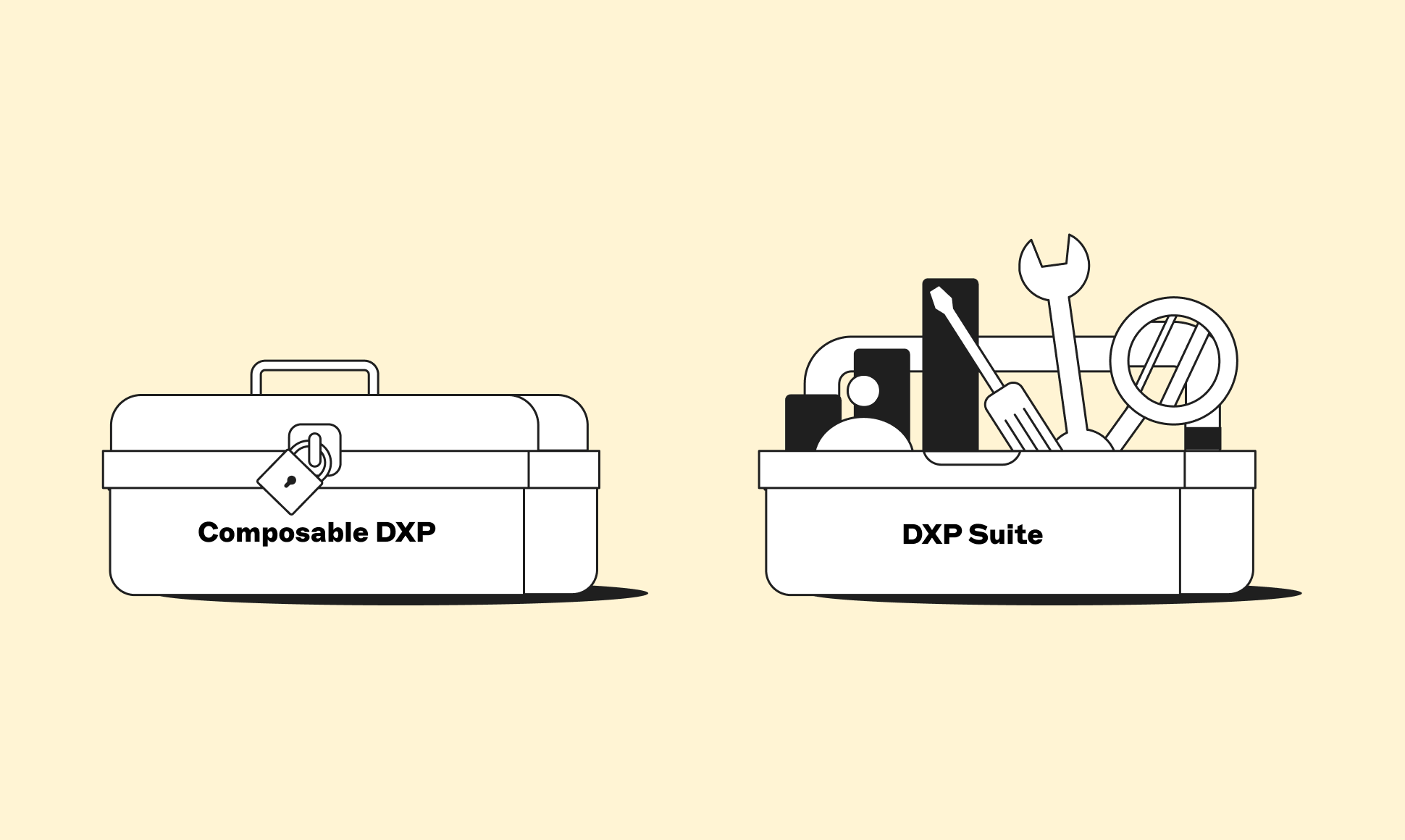
- A suite DXP bundles every layer—content, commerce, personalization, analytics—from a single vendor.
- A composable DXP assembles best-of-breed tools for each layer and connects them via APIs, with a headless CMS, such as Storyblok, typically chosen as the foundation the rest of the stack builds on.
But with so many tools on the market, how do you determine which is right for you? And does either actually deliver on the all-in-one promise, or just move the complexity somewhere else? Let's find out.
What is a digital experience platform?
A DXP brings together the systems a business uses to create, manage, personalize, and deliver content, so a customer's experience feels consistent whether they're on a website, in an app, or reading an email. Marketing, product and development teams draw on the same platform instead of maintaining disconnected tools.
Marketers use it to build campaigns, developers use it to build experiences, and content teams use it to publish at scale, all from one foundation rather than stitched-together tools.
What problem do DXPs solve?
The core challenge a DXP addresses is fragmented customer experiences across a growing number of digital touchpoints.
As businesses moved online, they accumulated a patchwork of disconnected tools. Each holding its own slice of the digital experience pie:
- A CMS for the website
- An ecommerce engine
- An email marketing platform
- A customer data tool
The result was inconsistent experiences, siloed data, operational friction, and spiraling costs.
DXPs emerged around 2013 to address exactly this. The idea was simple: instead of managing ten disconnected tools, why not bring them together—or connect them tightly enough—so that the experience delivered to audiences feels seamless, and the experience for the team managing it actually feels manageable.
The difficulty is in getting all those connected systems to talk to each other reliably and quickly enough to actually feel seamless.
Virgin Media O2 rebuilt its site on a composable architecture in just 24 hours, and now reports multi-million-pound annual savings as a result. That's the fragmentation problem, solved at scale: the same disconnected patchwork described above, replaced with a stack the team could rebuild and run in a day rather than months. Read the full story.
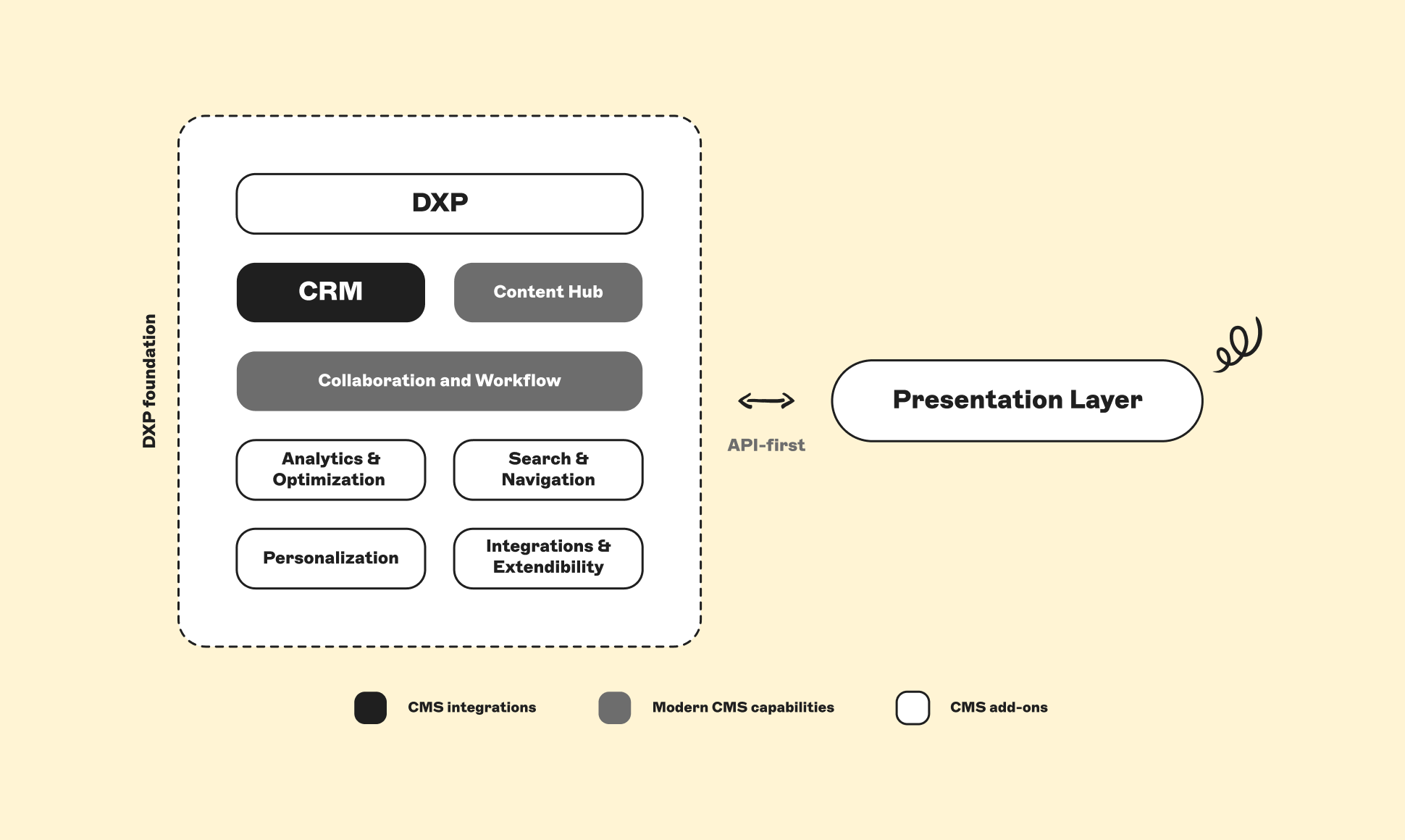
To solve the fragmentation problem, a mature DXP typically provides or connects:
- Content management and delivery across multiple channels.
- Personalization and segmentation based on behavior, profile, and context.
- Customer data unification, often via a built-in or integrated customer data platform (CDP).
- Commerce capabilities, including product catalogs, transactions, and merchandising.
- Digital asset management (DAM) for media at scale.
- Analytics and optimization to measure and improve experiences.
- An integration layer to connect existing tools and enterprise systems.
How much control you have over which tools fill each of those roles depends on whether you opt for a suite or a composable DXP.
DXP definition: The components explained
Every DXP is built from four layers, whether they come from one vendor or several.
- Content layer: Where content is created, structured, and stored, ready to be delivered anywhere via API. Storyblok is an example of a content layer built this way.
- Experience layer: The personalization and testing tools that decide what each visitor sees, based on behavior, segment, or context.
- Data layer: The customer data platform (or equivalent) that unifies profile, behavioral, and transactional data into one view.
- Integration layer: The APIs that let the other three layers, plus commerce, analytics, and CRM, work as one stack.
In a suite DXP, one vendor supplies all four. In a composable DXP, each layer can come from whichever vendor does it best.
CMS vs. DXP: What's the difference?
A CMS and a DXP solve different problems. A CMS manages and delivers content; a DXP adds personalization, customer data, and cross-channel orchestration on top of that content. That doesn't make them competitors: a headless CMS is commonly the foundation a DXP is built on, not an alternative to one.
Suite DXP vs. composable DXP: Which should you choose?
There are two main types of DXP on the market today, and the distinction matters more than most buyers initially realize.
The suite DXP
Suite DXP vendors (think Adobe Experience Cloud or Sitecore) have built a broad set of native, integrated tools all under one brand, largely through years of acquisitions. So the CMS, analytics, personalization engine, DAM, and commerce layer are all products from the same vendor, designed to work together out of the box. In essence, you’re buying into a fixed ecosystem of set tools, rather than connective software.
Benefits: Deep tool integration is handled for you, so you can get started faster.
Drawbacks: You’re tied to one vendor for every capability, some of which may not be best-in-class; it’s also expensive, and feature bloat is common.
Discover why teams are migrating to a composable approach and what they're gaining in this Sitecore and Storyblok comparison.
The composable DXP
A composable DXP takes the opposite approach. Rather than buying into a fixed ecosystem, you select the best tool for each job and connect them via APIs. Your CMS is one vendor, your CDP is another, your commerce layer is another, and so on. The DXP is the hub that the other tools connect to.
For a closer look at how composable DXPs are structured, see our full breakdown of composable architecture.
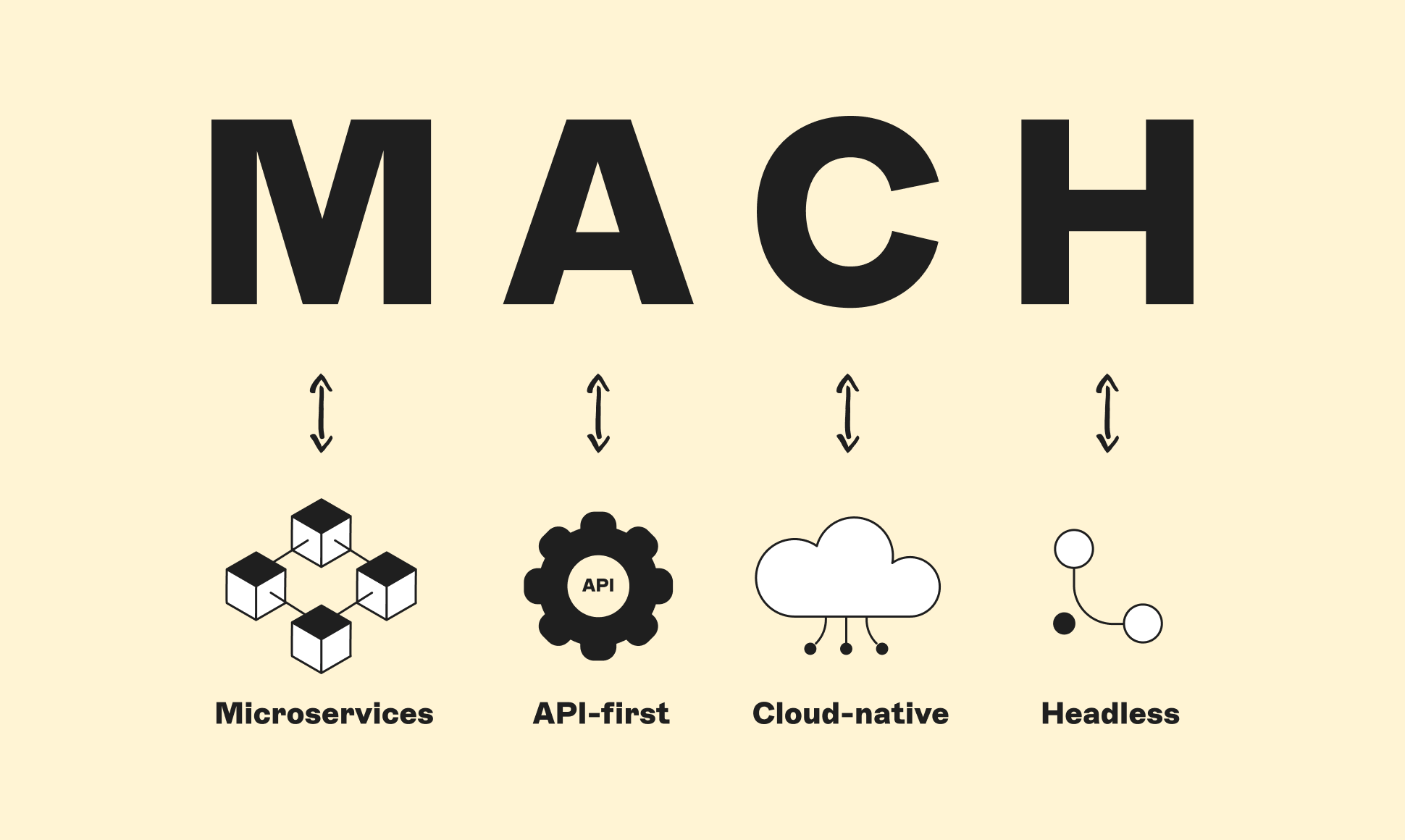
This approach is built on MACH architecture:
- Microservices: Independent capabilities that are loosely connected; each one can be updated or replaced without affecting the others.
- API-first: Every tool communicates via APIs, allowing data to flow freely between systems and channels in real time.
- Cloud-native: The platform runs entirely in the cloud, enabling scale, reliability, and faster deployment.
- Headless: The backend (where content lives) is decoupled from the frontend (how it's presented). Content is delivered via API to any channel or device: website, app, kiosk, or beyond.
Benefits: Flexibility, best-of-breed quality at each layer, and a stack that can scale with your business.
Drawbacks: You bear the integration burden, requiring significant technical capability to set up and manage.
Download The Content Revival: Lessons From Brands Winning With MACH for a practical guide to MACH architecture in action.
Why content management is at the heart of every DXP
Regardless of which type of DXP you choose, one capability underpins everything else: content management. Every personalized experience, every product page, every email campaign, every app screen—it all starts with content. How that content is created, stored, and delivered determines how effectively the rest of your DXP stack can do its job.
But here's where the suite and composable models diverge in a meaningful way that has real operational consequences.
With a suite DXP, the CMS is provided by the vendor, and you're stuck with it. It may be capable, but it's rarely best-in-class, and because it's tightly coupled to the rest of the suite, replacing or supplementing it is difficult and costly. Your content foundation is, in effect, chosen for you.
With a composable DXP, the CMS is typically the foundational layer you choose first, the hub that other tools connect to and draw from. Get it right, and the rest of the stack has something solid to build on. Get it wrong, and no amount of analytics or personalization tooling will compensate. The good news is that the choice is yours.
For teams that need to deliver high-quality content across multiple channels and regions quickly, without depending on developer resources for every update, a headless CMS is the go-to choice. Unlike traditional CMS platforms (and suite DXPs), which are tightly coupled to a specific frontend, a headless CMS stores content in a structured, channel-agnostic way and delivers it via API to wherever it's needed. The result is faster publishing, greater flexibility, and a clean separation between content and presentation.
In our new AI-driven, multichannel reality, a headless CMS is the tried-and-tested system modern teams need to deliver on market expectations. This IDC report lays out the case for headless.
Is Storyblok a DXP?
No, Storyblok is a headless CMS, not a DXP. It's the content layer that sits at the foundation of a composable DXP: the piece where content is created, structured, and delivered via API to whichever commerce, personalization, and analytics tools a business connects around it.
Storyblok doesn't provide those other layers itself. If you need a single vendor to supply commerce, personalization, and analytics out of the box, a suite DXP is the better fit. If you want to choose your own best-of-breed tools for those layers and build on a strong content foundation, a headless CMS like Storyblok is where that stack starts.
See how Storyblok works as the content foundation of a composable stack on our platform page.
Open source DXP options
Open source options exist at nearly every layer of a DXP, including open source CMSs, personalization engines, and search tools. They offer full control over the codebase and no licensing fees.
The trade-off is total cost of ownership: open source software still needs hosting, security patching, scaling infrastructure, and in-house expertise to integrate with the rest of a DXP stack, costs that exist whether or not there's a license fee attached. A commercial headless CMS takes on that hosting, maintenance, and integration work, which tends to shorten time to value for teams that want to build a composable stack without maintaining the infrastructure themselves.
What to look for in a DXP
If you're evaluating DXP options, here are the questions worth asking:
- Flexibility: Can you swap out tools as your needs evolve, or are you locked into the vendor's ecosystem?
- Integration capability: How easily does it connect with the tools you already use, such as your CRM, your analytics platform, and your commerce layer?
- Content management: Is the CMS powerful enough for your editorial team and flexible enough for your developers?
- Scalability: Can the platform handle growth in traffic, content volume, and new channels without a costly rebuild?
- Total cost of ownership: Beyond licensing fees, what are the implementation and ongoing maintenance costs?
- Editor experience: Can nontechnical marketers publish and preview content without developer help?
- Personalization support: Is personalization native, or is it delivered through an integrated third-party tool?
- Vendor lock-in risk: How easily could content and configuration migrate elsewhere if you needed them to?
Is a DXP right for you?
A DXP isn't the right fit for every business. For smaller organizations with a single website and modest content needs, the complexity and cost of a full DXP—suite or composable—may be hard to justify. A well-chosen CMS and a handful of integrated tools may be all you need for now.
For larger teams, the appeal is understandable. If you're wrestling with disconnected tools, inconsistent experiences, and content that takes too long to get out the door, a DXP can feel like the obvious answer. And often, it is. But a DXP is only as good as the technology decisions made within it, particularly at the foundational level. Choosing the wrong tools, or defaulting to a suite that locks you into mediocre ones, can leave you with the same frustrations you started with, just wrapped in a more expensive package.
That's why, as discussed above, your base tool choices matter most, and none more so than your CMS. It underpins every experience your audience sees, and a modern, headless, API-first platform is what determines how good those experiences can be:
- True composability: Rather than content sitting siloed behind a single frontend, it flows via APIs to every tool in your stack and channel in your strategy, giving you genuine flexibility to evolve the stack over time.
- AI-readiness built in: Personalizing at scale, component-based content, auto-translating for new markets—none of it works if your content is locked inside templates that AI tools can't query or act on. Structured, API-deliverable content is what separates teams that can move fast from those stuck in the past.
- Freedom for developers and marketers alike: The best headless platforms offer real-time WYSIWYG visual previews and intuitive editing workflows, so content teams can publish without waiting on development support, and developers can build without being blocked by content requests.
So, is a DXP right for you? If your current CMS is slowing your team down, limiting your channels, or standing between your editors and your audience, you already have your answer, and that's the first thing to fix. Everything else builds from there.
Storyblok is the headless CMS built for teams who need to move fast and deliver across every channel and market in real time. Give your developers the flexibility they need and your editors the autonomy they deserve—without compromise. Start your free trial.
Frequently asked questions (FAQs)
Is a DXP the same as a CMS?
No. A CMS manages content. A DXP combines content management with personalization, data, and omnichannel delivery. A CMS (including a headless CMS) is commonly one component inside a DXP, not a replacement for the whole platform.
Do I need a DXP, or is a headless CMS enough?
It depends on scope. A headless CMS alone covers content creation and API delivery. A full DXP is worth considering once personalization, cross-channel orchestration, and integrated customer data become genuine requirements, not just content storage.
How much does a DXP cost?
Suite DXPs bundle every layer into one license, typically the highest-cost option. Composable DXPs let a business pay only for the components it needs, which usually lowers total cost but requires integration work.
What is a composable DXP?
A composable DXP assembles best-of-breed tools, such as a headless CMS, commerce, search, and personalization, connected via APIs, rather than buying every layer from a single vendor.
Can I build a DXP with a headless CMS?
Yes. A headless CMS such as Storyblok can act as the content layer of a composable DXP. Add commerce, personalization, and analytics tools around it, connected via API, to reach full DXP functionality without buying a suite.